This Week I Played
OMELET YOU COOK
pixel-based cooking roguelike
Quick stats
Playtime: 6 hours (4 hours past refund)
Price: $14.99 USD, £12.79 GBP (at time of review)
I paid: Nothing (from my Steam family library!)
A roguelike done rogue-right
Omelet You Cook is a cooking-based roguelike game, with a fun way of combining and stacking effects similar to an auto-battler. It is essentially turn-based, but can optionally be played with a turn timer - more on this later. Now, before I get into specific details about the game, I need to get one thing out of the way: according to some people's definitions, Omelet You Cook is actually a rogue-lite, not a true rogue-like. This is because there is a system of progression between runs: if you do well with your ingredients, you unlock new ones for future runs. Of course, this isn't a mechanic in the original Rogue, so some people consider games like Omelet You Cook not to be truly roguelike (the assumption being that, because the word roguelike
comes from Rogue
etymologically, people are expected to know what Rogue is and derive the meaning from that, which is an excellent example of the etymological fallacy). In my opinion, however, this is like saying that flight is not a typical property of birds, because the original birds (dinosaurs) couldn't fly. Just because Rogue didn't have metaprogression, doesn't mean that the term roguelike (which, for people who haven't played or even heard of Rogue, is an independent word in their mental lexicon) can't refer to something which does have metaprogression. Indeed, parallel to the bird example, I would go so far as to say that I expect a roguelike to have metaprogression.
With all that said, Omelet You Cook does a lot of things right. Its two main appeals are number go up
and the glee of combinatorics. Few things in games like this are quite as fun as thinking what if, this run, I try combining strategy X with strategy Y?
and then it actually working. The core gameplay loop is this: each round, you make an omelette for a new customer, adding ingredients as toppings on said omelette to try to get as many points as the customer requires; if you succeed, you earn money and keep playing, allowing you to go to the shop and buy new ingredients or helpers, which provide passive buffs. Like in auto-battlers, ingredients have various (overlapping) classes, based on their food group (e.g. veggies, meats and fungi), texture (soft, chewy and/or crunchy) and method of preparation (raw, baked or processed). Some ingredients and helpers then have abilities which interact with these, like Sausages, which score more points for each veggie they're touching, or the Texture Specialist, who gives all of your ingredients extra points if you manage to combine all three textures on your omelette. This is where a large amount of the combinatorial fun comes in, with certain ingredients (like Sausages, in fact, since they are meats that interact with veggies) serving as pivots between strategies. In my most recent run, for example, I started by trying to accrue baked ingredients, but then I realised that the Pumpkin Pie I was using to get extra points from said baked ingredients was sweet, which meant I could (and did) pivot to a sweet-based strategy.
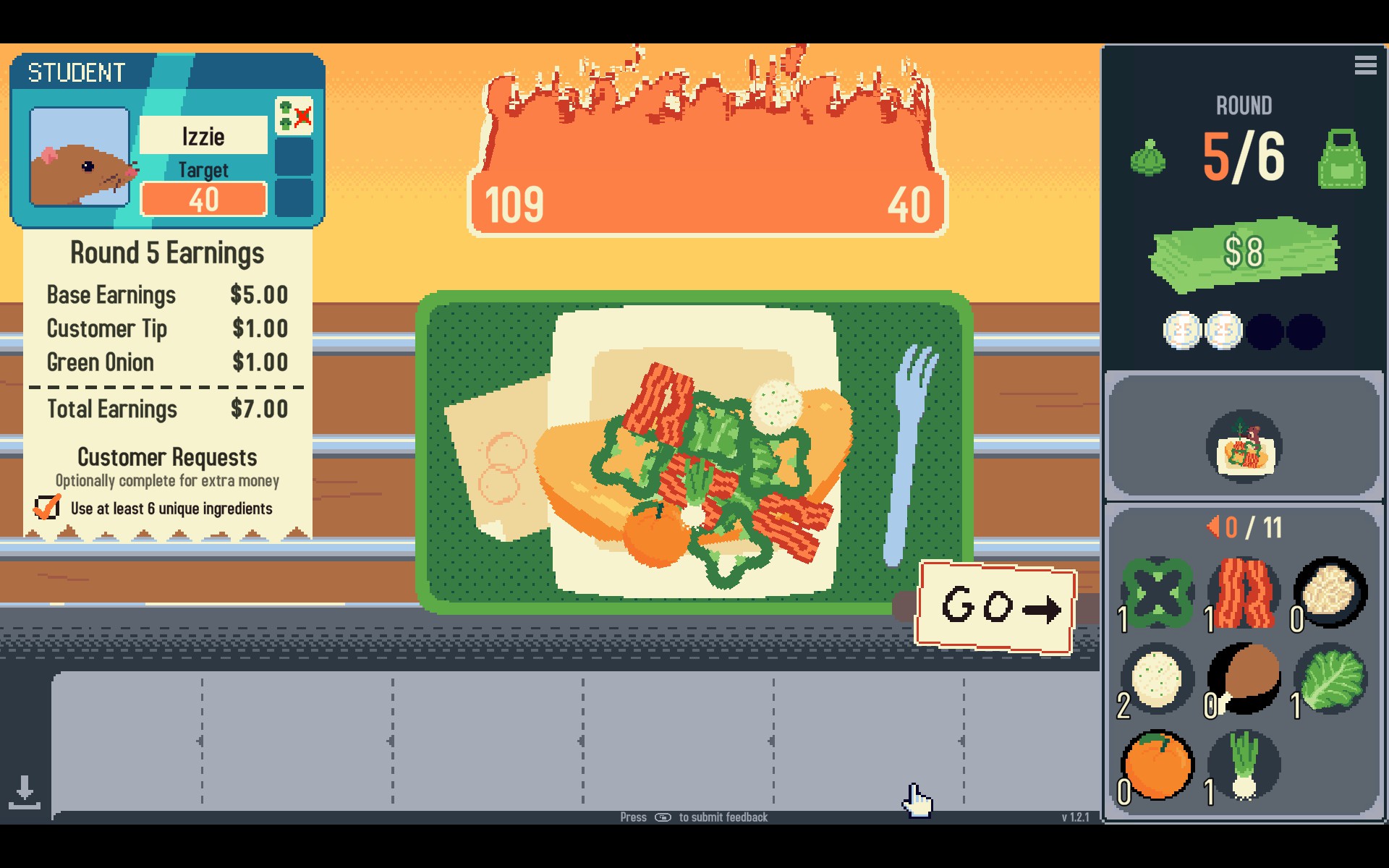
A scrumptious combination of ingredients, perfectly placed
The thing which makes Omelet You Cook a unique experience, and truly makes the different strategies you could pursue actually feel different, is the fact that it is positional. Ingredients must be placed on the omelet, and they must fit on it in order to score any points at all. Crucially, however, several ingredients refer to positonal relationships with other ingredients: Sausages, as mentioned, score their points by touching veggies; Pumpkin Pies score points from baked goods which the slice is pointing towards; and most of the fungi score points by having other ingredients not touching them, but in a ring around them. The beauty of this is that it adds a lot of strategic depth to the gameplay, while also giving fungi, for example, a distinct identity and feel.
Everything and the kitchen sink
And the devs really take these mechanics and run with them. Omelet You Cook is a quintessential version of variations on a theme. As mentioned, different ingredients deal with relative positions in different ways, but there are several keywords which take this to a new level. Sticky ingredients have a chance to physically stick to ingredients already on the omelette, meaning they can't be moved without moving the whole clump; Wiggly ingredients, on the other hand, are alive, and have a chance to move independently across the omelette, knocking other ingredients out the way. These are just two examples out of like 10. There are also ingredients which overlap or underlap other ingredients, like slices of Cucumber or leaves of Lettuce, respectively. Of course, the customers are included in this mechanical proliferation too: some customers are Superstitious, meaning that they won't let you move ingredients after you've already placed them (unless you scooch them out the way while holding another ingredient), while Egg-Laying customers will leave egg shells strewn across the omelette, disrupting your original plan and scoring negative points if you don't take them off (which may be tricky if the customer is also Superstitious...).
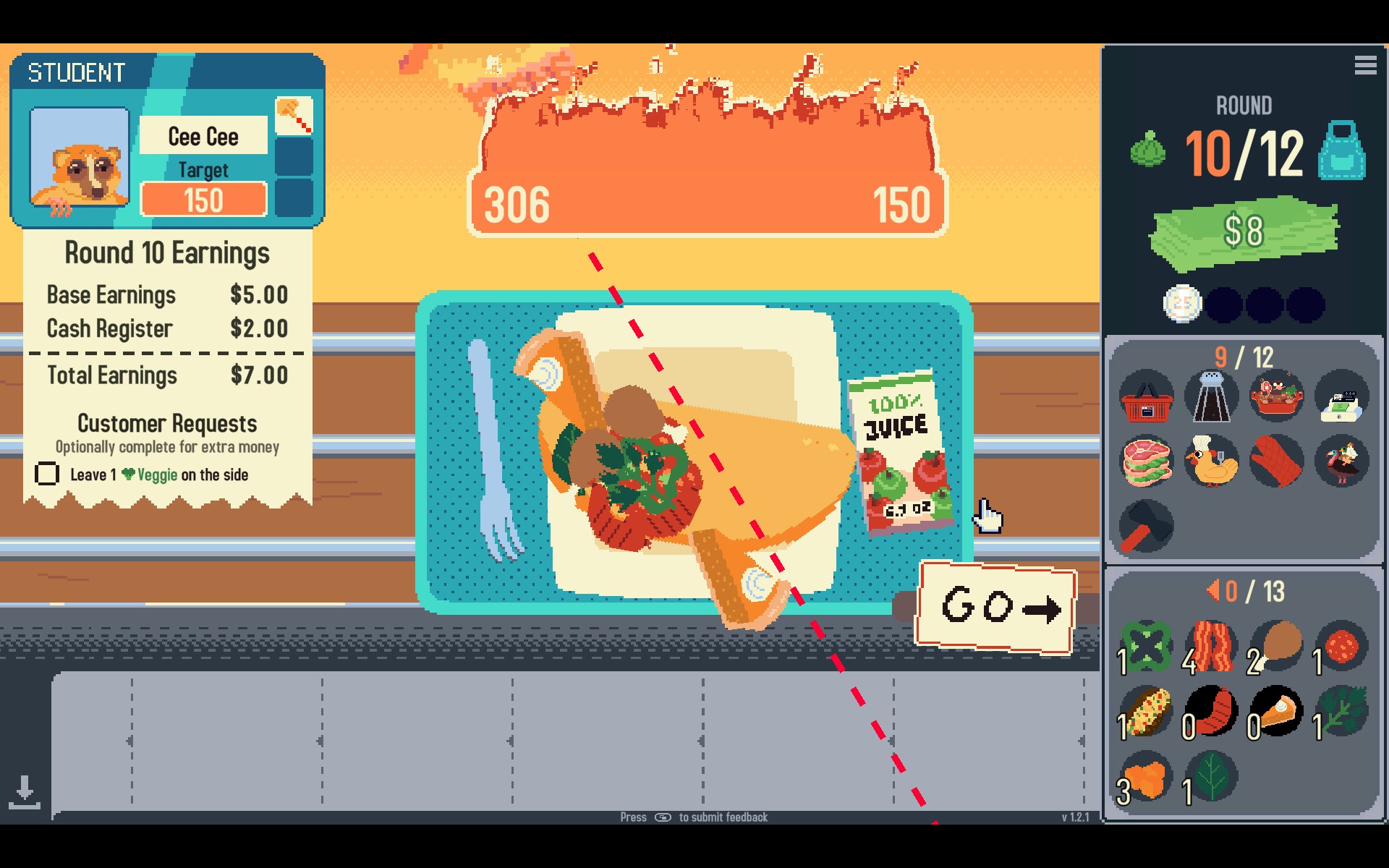
This bastard wouldn't let me put ingredients where he was pointing
Omelet You Cook also plays with time as a variable. In the mode which has a timer, your ingredients arrive on a conveyor belt which moves faster depending on the difficulty. Customers can also have traits which make this difficult, like Impatient, which makes the conveyor move even faster, or Wannabe DJ, which makes the omelette rotate while you're trying to add toppings to it. And of course, ingredients play into the time panic too, with Spicy ingredients scoring extra points, but carrying a risk of scorching themselves and everything around them if they are left too long - or you can waggle your cursor around to put them out, but then you won't score the bonus points. Trade-offs like these are what make roguelikes fun; trade-offs like these when they are incorporated in a mechanically interesting way make them special.
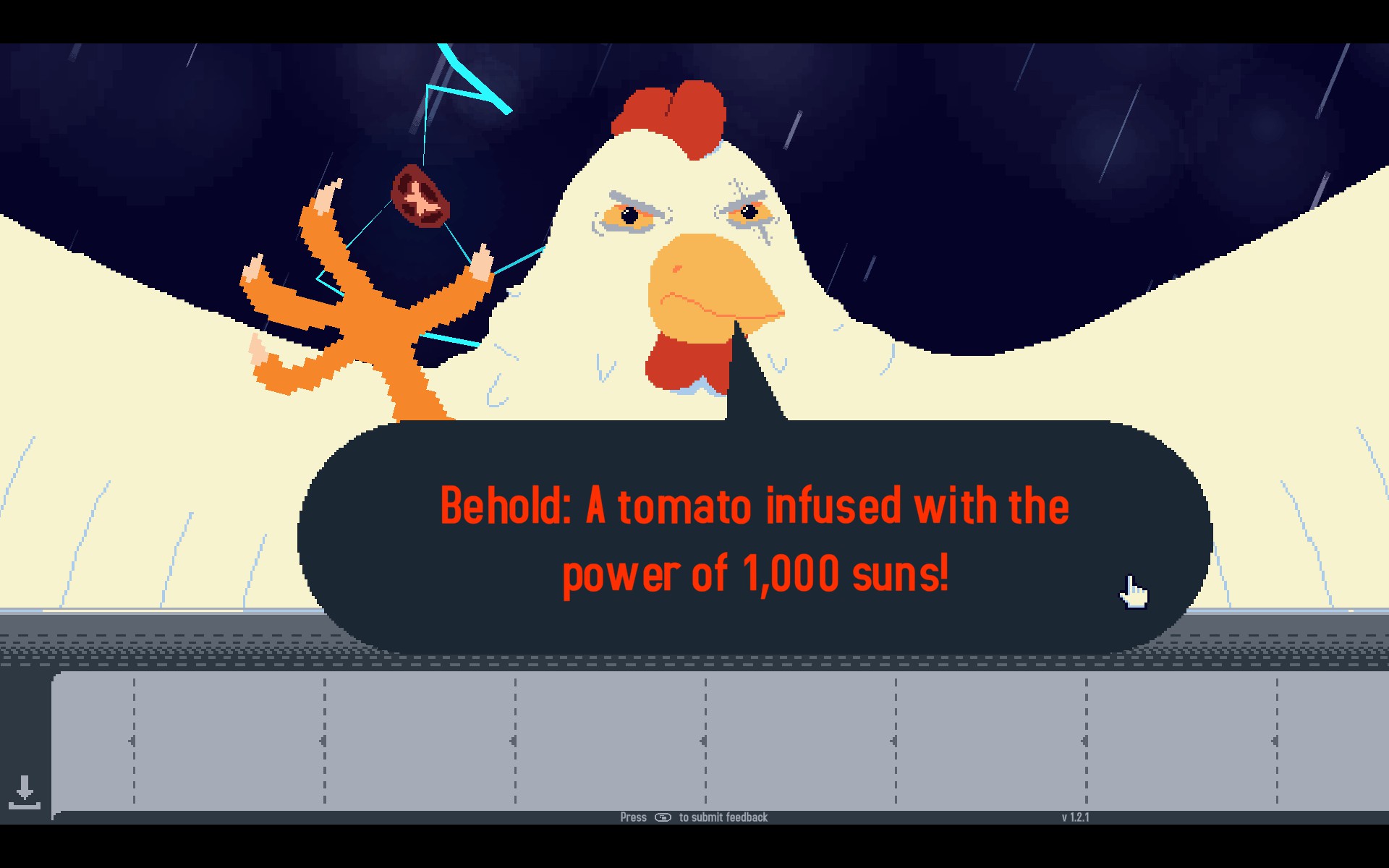
The game's sense of humour is pretty good
Another thing I really love is the metaprogression system. Instead of the game just becoming easier, it simply becomes more varied (which in a game which combines luck and skill, might actually make it harder), with new ingredients (and therefore new combos) being unlocked as you keep playing. You can also unlock new difficulty levels to beat, as well as different combinations of starting ingredients and helpers, unlocked by completing certain challenges. They've even added a weekly mode, with a different starting setup each week, allowing for a lot of replayability. But what I find cool is that ingredients are unlocked by scoring points with other, similar ingredients, and they are introduced with fitting dialogue with a giant chicken.
Burnt bits
It's clear that, like all good homecooking, this game was made with a lot of love. But, also like all good homecooking, some things don't quite pan out right. The narrative of the game, for example, feels a bit slapdash. All your customers are teachers and students, but it's not quite clear why; and this giant, slightly cosmic-horror-inducing chicken keeps devouring all your food, giving you new ingredients, and ramping up the difficulty of the game, but I don't get what that has to do with anything, other than being kinda funny. It doesn't feel like it gels with the rest of the game, to me. Most of the time something like this crept in while I was playing, I found myself feeling like it was a distraction from the game I actually wanted to play, which was making the omelettes. This isn't a huge problem, because narratives don't have to be central to roguelikes (though there are some which really lean into storytelling), but to continue the culinary metaphor, Omelet You Cook's narrative just seems a little undercooked, and though it's not overpowering, I'd rather it weren't on my plate.
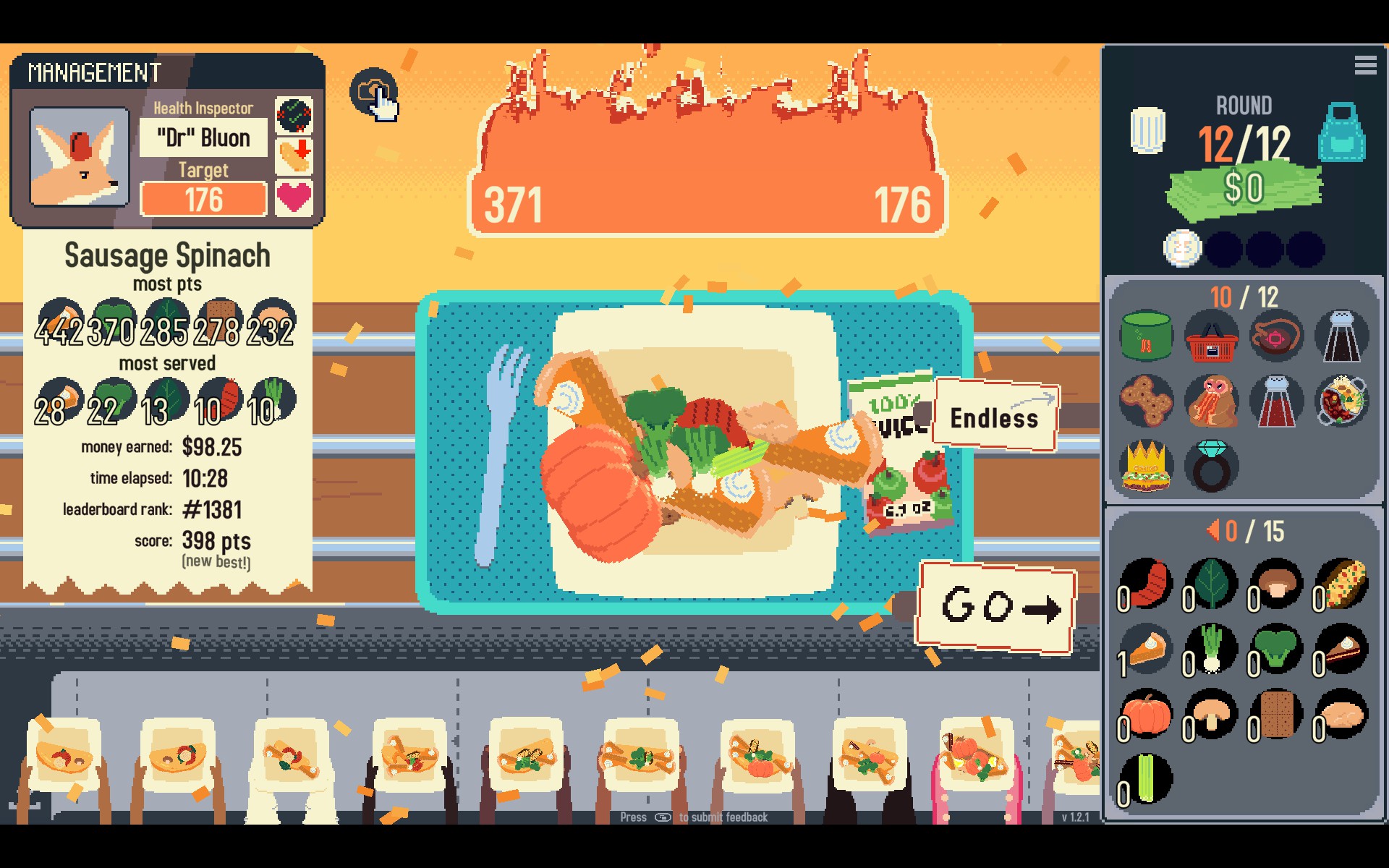
This combo got me a lot of points but doesn't look the tastiest IRL
I have a couple of niggling issues, as well, one of which affects me slightly more than the other. First, I can't tell if I like the fact that ingredient combos which work well in the game don't necessarily translate to real life. Second, PLEASE GOD SOMEONE SILENCE THE BIRD FROM THE TUTORIAL I CANNOT BEAR THE NOISE OF ITS DIALOGUE. The foley is pretty good though, and the music's not bad - it's just that fucking bird.
Will I play more?
Yup! I'm about to play it right now actually - I'm really enjoying this one :)