This Week I Played
The Witness
colourful, open-world puzzles
Quick stats
Playtime: 3.7 hours (1.7 hours past refund)
Price: $39.99 USD, £29.99 GBP (at time of review)
I paid: £8.80 for a Humble Bundle containing this game
Lonely island
The Witness takes place on an island. There's no introduction, no indication of where you've come from or how you've got here: the puzzles just begin. The first thing that dawns on you as you explore the island is that, while covered with what appear to be human settlements, it is entirely uninhabited. The settings menu mentions subtitles, but as yet, I haven't seen any - there's no-one to talk to, and the game does a good job of making you feel alone out there. Even the Steam page is relatively austere: few details are given about the game or its setting, just that you will be alone.

Just me and the ocean
The main objective of the game is to solve puzzles and use these to explore the island. It's open-world, but unlike in some games, you cannot simply go anywhere. Some routes are gated off, while others feature puzzle mechanics introduced elsewhere on the island, requiring you to come back and solve them later. I find this frustrating, personally, in the same way as games like Hollow Knight, where despite being 'non-linear', sometimes your progress bottlenecks at one particular point, meaning you can run around in circles for ages trying to find the one thing which will let you proceed. My friend who bought me Hollow Knight can attest that I once spent 1-2 hours looking for a way to progress, because there was one place on the map that I hadn't checked, and there was no way to progress without visiting that area. I'm sure people who are better at orientation might not find this so limiting, but for me it kind of spoils the open-world vibes. If being able to complete one puzzle depends on completing another, can you truly say they're not in a linear sequence?
To be clear, I don't think The Witness is not an open-world game either. I just think that there's a spectrum of open-world-ness, and I would have preferred it to be further in that direction, given the importance of exploration and discovery as the soul of the game. I have similar feelings about that early bit in Hollow Knight. Also, unlike in Hollow Knight, traversing the map doesn't tend to be that fun, because the character walks rather slowly, and you can't even jump, which it turns out is something I tend to like doing in games.
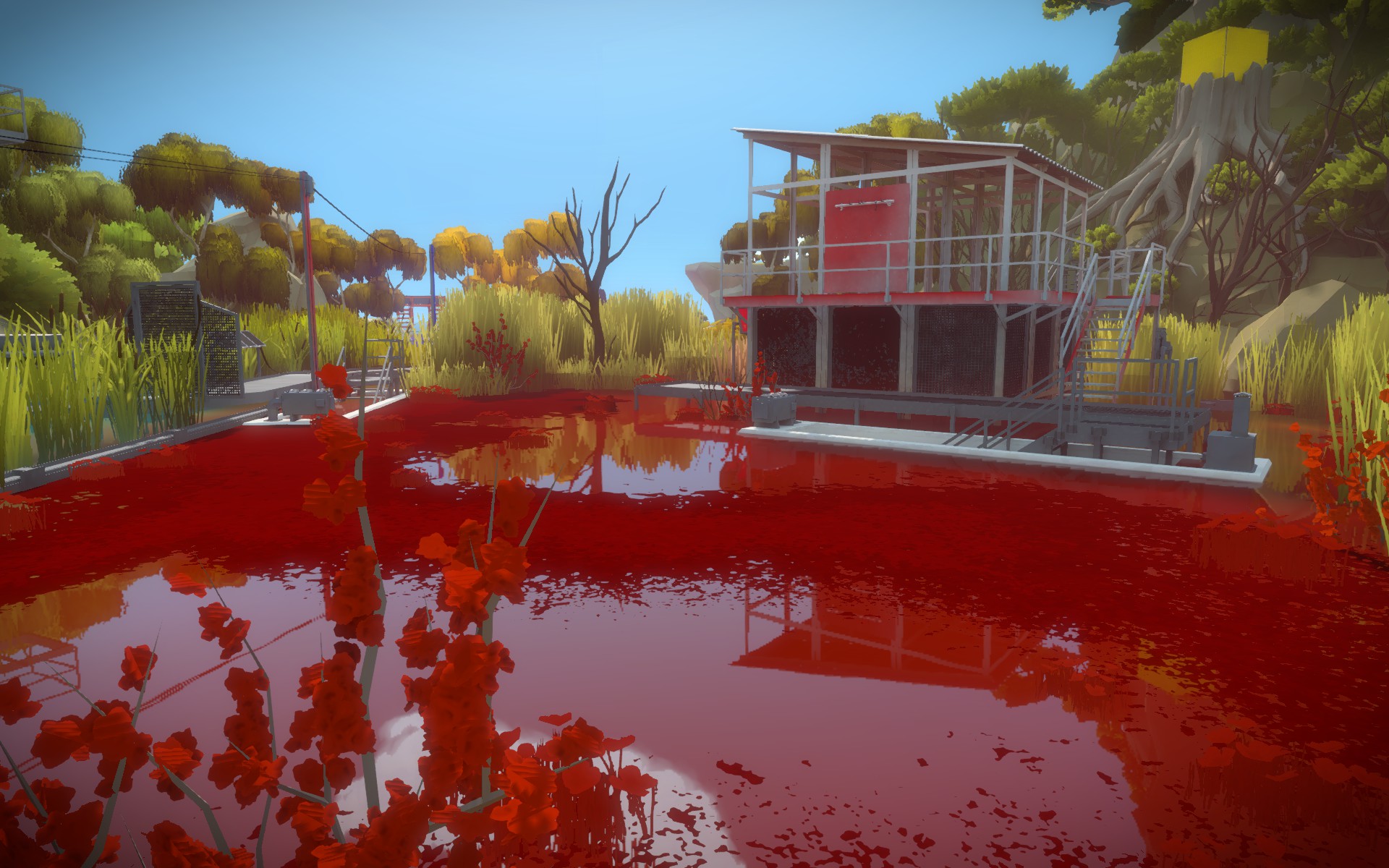
The Witness does a great job of balancing colours dynamically
Aesthetically, the game is gorgeous. Or, rather, I'm sure it would be if my computer could run it on settings higher than low
. I like what I can see of its art-style though: bright, unapologetically colourful natural scenery, with more muted manmade structures occupying the foreground. I'm sure this will end up being relevant thematically. Also, the game deftly intertwines the manmade and natural worlds in some of its puzzles. I won't spoil anything, but some puzzles require you to look at natural elements placed nearby, in conjunction with the presumably manmade puzzle screen you're using.
Learning curves
One thing which is hard to get right in a puzzle game is making sure that the learning curve is good. If puzzles start too easy or too hard, players won't bother in the first place, but also if they ramp up in difficulty too slowly or too quickly, players will likely lose interest. Although it isn't perfect, I think The Witness does a really good job here. The game features one basic puzzle: a grid, through which you have to draw one long, continuous line, from the start to the end. But every area in the game adds a different mechanic to the puzzle: early on, you learn that you must use the line that you draw to separate black squares from white, for example, or that you must pick up all the little grey shapes along the way. The starting macro-area is honestly a perfect example of how this system thrives. You begin the game by learning how to do puzzles in general. Then, you pass by a puzzle which has all kinds of funny symbols on it, so it's hopeless to really try (see above for my criticism of this in general, but here I think it works because the solutions are - literally - right around the corner). After seeing this, the game branches out, and you glimpse the whole island spread out before you. Nearby, however, there are basically two areas, which teach you the two mechanics just mentioned. With these in hand, you can return and complete the tricky puzzle you walked past. The Witness does this really well.
I want to expand on this slightly, though, because it does something really impressive, which makes its puzzle areas incredibly satisfying. It effectively employs the principle of kishotenketsu, a Japanese writing technique involving four stages. In the context of a puzzle game, these are the following: first, a new mechanic is introduced; second, it is developed in harder puzzles; third, it is 'twisted' in some way, requiring you to rethink what you knew about it or use it in a way you haven't tried before; finally, you put it all together for a final challenge. This is explained well by Game Maker's Toolkit. A prime example of this in The Witness is an area you reach fairly early. First, you learn that in some puzzles, you draw two lines simultaneously, with one line being the mirror image or rotation of the other. Then, this is developed: in order to collect the grey shapes from some of the other puzzles, you have to figure out which line to collect them with (eventually, the lines change colour, too, requiring even better matching). The twist comes when the second line starts becoming more and more transparent; this concludes in a final puzzle where you can't even see the other line you're drawing, but you nonetheless need it in the right place to meet the requirements. 10/10, no notes.
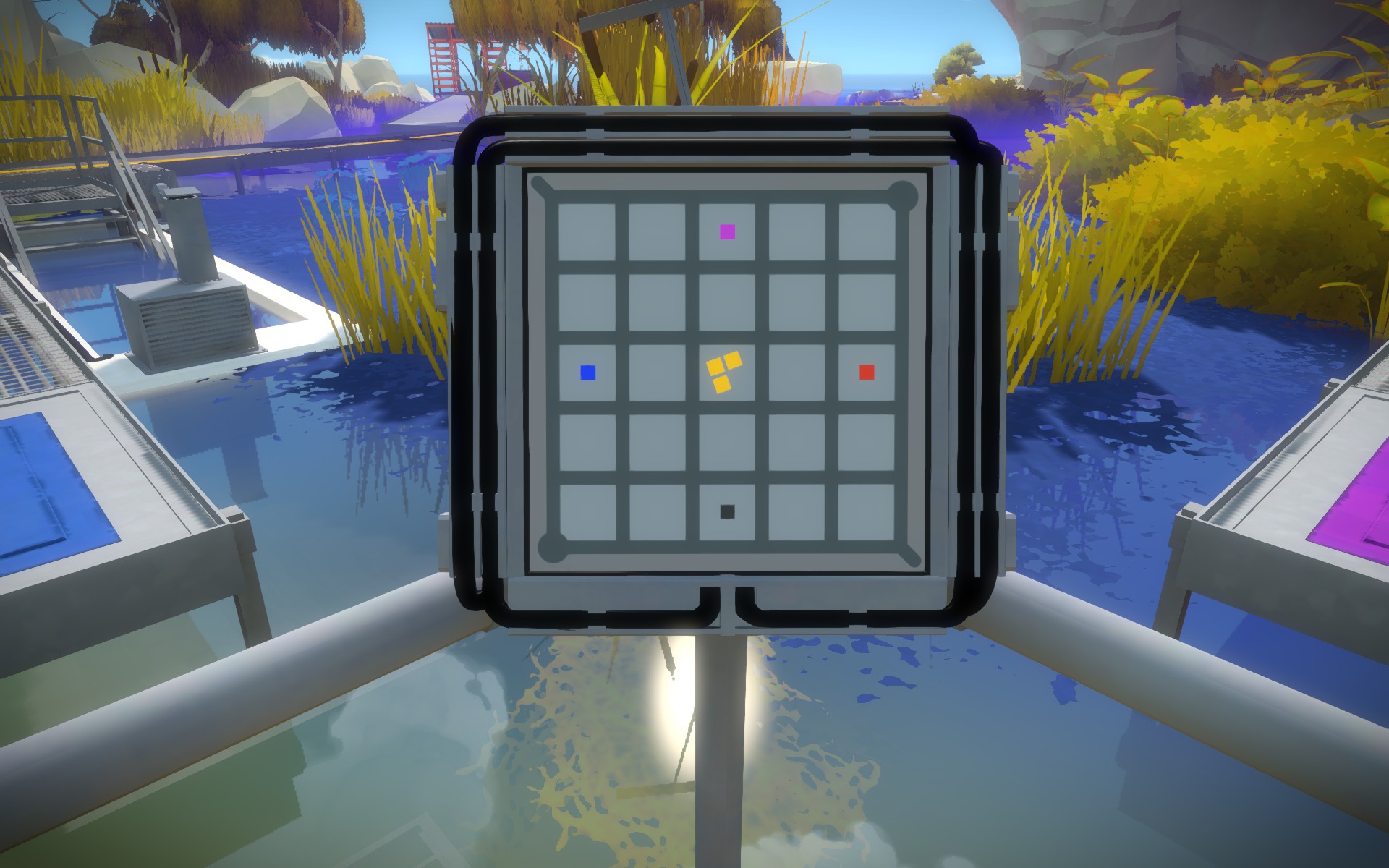
Oh sweet Jesus
Where The Witness really shines, though, is that these mechanics aren't just thrown away, as they are in some games (like Super Mario 3D World, linked above). Instead, you find puzzles later on in the game which require you to make use of the mechanics you learn along the way, like the double lines. This may even come with an additional twist: no spoilers, but the 'segregate the colours' mechanic receives some interesting twists later on. Unfortunately, it is this same amazing aspect of the game which makes it less open-world-y, due to the requirement of completing previous puzzles to be able to solve subsequent ones (again, do the notions previous
and subsequent
make sense in a truly open-world game?).
Friendship is magic
As mentioned above, The Witness gives you a strong sense of isolation, intentionally. Also as mentioned, its learning curve is fairly good. But sometimes it isn't. Sometimes your fun can be interrupted by a puzzle which takes you half an hour to complete. Sometimes you need a friend - or several.
It feels like it's not really in the spirit of the game, but I found playing this game with friends to be incredibly fun and rewarding. What started as me exploring, having fun and occasionally getting frustrated on my own, turned into me and a friend teaming up to solve problems, which then evolved further into a whole group of us chipping in to figure out a particularly confusing set of puzzles. I really enjoyed it, and I feel like it struck a good balance between cooperation and congratulating individual insights and contributions.
Will I play more?
Yes! I want to finish it! I was recommended this game by a friend, and I'm looking forward to discussing some of the later content with him.